
Search Montgomery County Traffic Court Records
Traffic cases in Montgomery County use statewide North Carolina court tools rather than a county-built ticket database. The North Carolina Judicial Branch traffic violations topic explains that every traffic ticket has a court date. Some tickets can be handled without appearing in court by using online waiver, payment, reduction, or dismissal options when the offense is eligible. Court dates and case information may also be checked through the North Carolina eCourts Portal, which supports case search, hearing search, and some payments.
For Montgomery County traffic court records, start with the citation number if it is available. A name search can help with court dates, but common names may return multiple results. The court record may show a citation, charge, statute, court date, waiver status, plea or disposition, fines, costs, and failure-to-appear or failure-to-pay status. Certified copies and older paper traffic files still come from the Clerk of Superior Court at the courthouse in Troy.
- Read the citation and identify the citation number, county, charge, and listed court date.
- Use Citation Services or Portal hearing search to check whether online waiver, reduction, dismissal, payment, or court-date lookup is available.
- Select Montgomery County when the tool asks for county or location, then search by citation number, name, or record number.
- Review the traffic court record for waiver eligibility, disposition, fines, costs, and any missed-court warning.
- Contact the Clerk of Superior Court if the online record is unclear, the case is not waivable, or a certified traffic court copy is needed.
The traffic violations source from the North Carolina Judicial Branch is the official statewide explanation for waivers, reductions, failures to appear, and DMV notice rules.
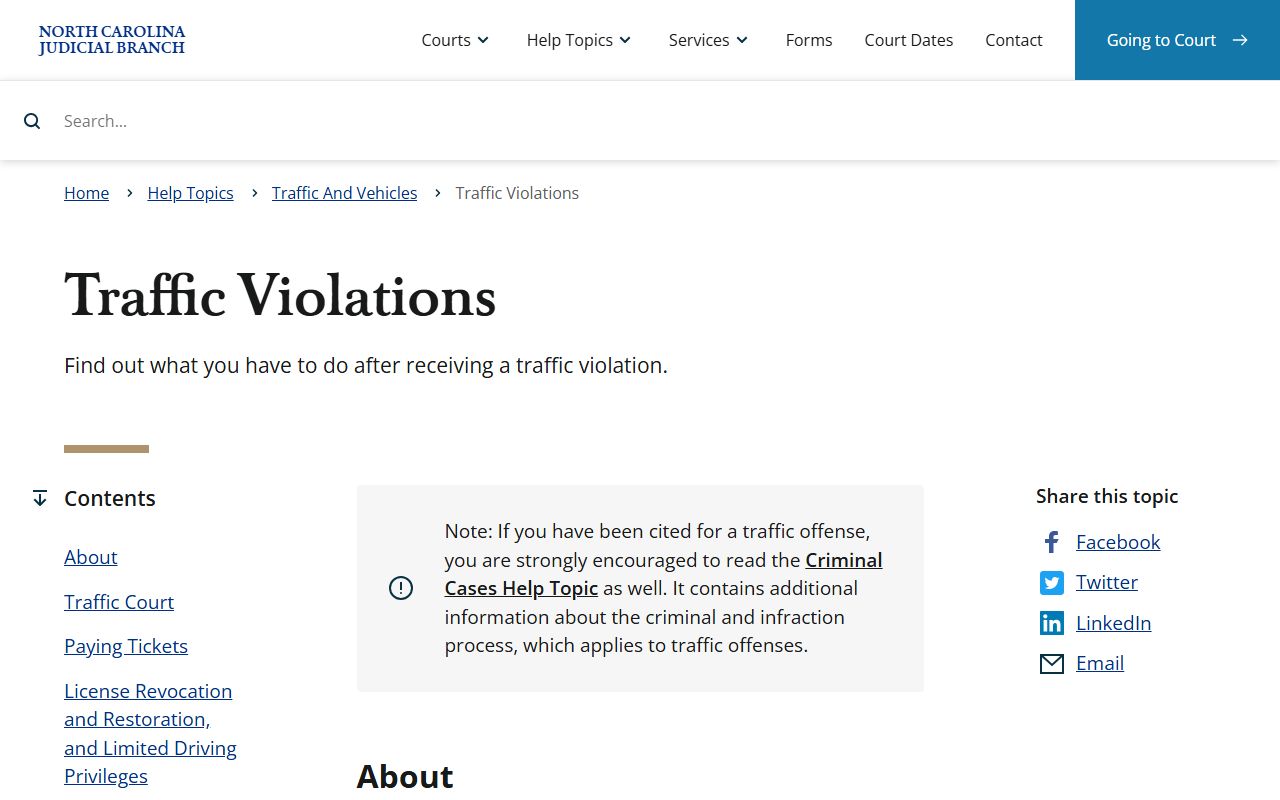
That source matters locally because Montgomery County traffic cases follow the same District Court traffic process described by the state court system.
Montgomery County Traffic Court Venues
Traffic citations in Montgomery County are District Court matters. North Carolina does not run a separate Montgomery County municipal court system for traffic tickets, even when the stop or crash involved a town police department. A Troy Police Department or Biscoe Police Department incident may create a law-enforcement report, but the resulting traffic court record is handled in the state court system. Smaller counties may hear traffic tickets on crowded criminal dockets, so local timing should be confirmed with the clerk before the court date.
The District Court hears infractions, misdemeanors, and traffic cases without a jury. Magistrates may handle limited waiver or initial criminal process functions, while prosecutors handle ticket prosecution and eligible online reductions or dismissals. Felony matters and appeals from District Court move differently, but ordinary traffic tickets, waivable infractions, and many traffic misdemeanors start at the District Court level in Troy.
| Court or Office | Traffic Role | Local Contact |
|---|---|---|
| District Court | Hears Montgomery County traffic infractions, traffic misdemeanors, waivable citations, and contested ticket matters. | Montgomery County Courthouse, 108 E Main St, Troy, NC 27371 |
| Clerk of Superior Court | Maintains traffic court files, receives some payments, supports court-date questions, and provides copies. | (910) 571-3700 |
| Magistrates | Handle some minor matters and court process questions allowed by law. | (910) 572-2866 |
The statewide District Court overview describes the court level that handles traffic cases, misdemeanors, infractions, family cases, juvenile matters, and magistrate work.
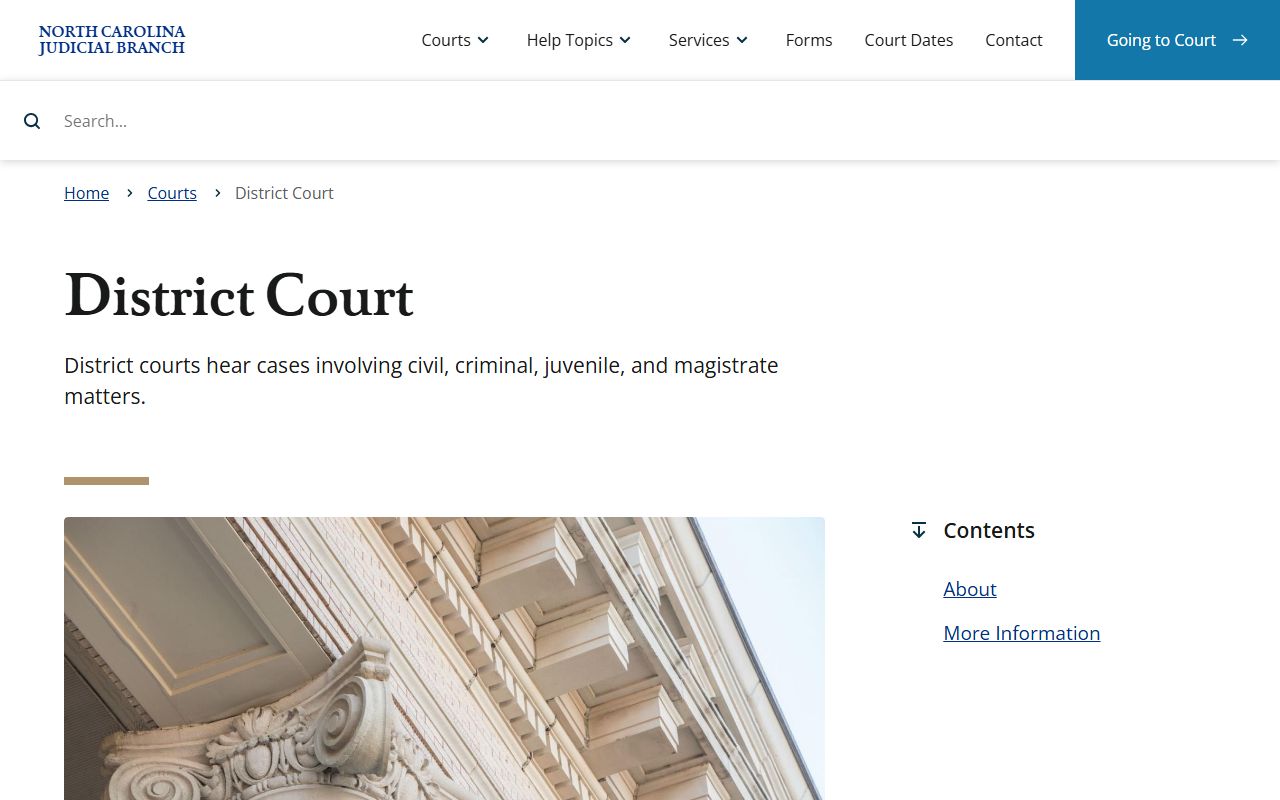
The District Court source supports the Montgomery County venue rule: the ticket record belongs in the state trial court system, not in a town court docket.
Montgomery County Citation Search Fields
Traffic search tools use a narrow set of fields because a citation is tied to a specific case, person, county, and court date. The citation number is the best starting point for payment or waiver services. A court-date search may allow a name, citation number, county, case number, or date range. Portal case numbers for criminal and infraction matters may include the last two digits of the year plus letters such as CR for a criminal offense or IF for an infraction-only case.
| Field Label | Type | Required | Options / Format Notes |
|---|---|---|---|
| Citation number | text | often required for citation services | Used for payment, waiver, reduction, or dismissal eligibility. |
| County | dropdown or filter | tool dependent | Select Montgomery County when the search form asks for the county. |
| Name | text | optional in court-date search | Portal hearing search supports name and citation-number searches. |
| Case number / record number | text | optional | Traffic records may use year-based CR or IF case number formats. |
| Court date | date or date range | optional | Useful when searching hearings or checking an upcoming traffic docket. |
| Payment method | card fields | required for online payment | Portal accepts Visa, MasterCard, and Discover, but not Apple Pay, Google Pay, Cash App, or Venmo. |
Note: Portal uses JavaScript, cookies, and periodic CAPTCHA, so a failed online search does not mean the clerk has no record.
What Montgomery County Traffic Records Show
A traffic court record is the case file for the citation. It is built around the offense charged in court, the hearing or waiver path, and the court outcome. It is not the same as a police crash report, and it is not the same as a DMV driver history. A traffic record may be short when a driver waives an eligible offense and pays online. It may be longer when the charge is contested, reduced, dismissed, tied to a missed court date, or treated as a criminal traffic offense.
| Field | What It Shows |
|---|---|
| Citation number | The ticket identifier used for Citation Services, court-date lookup, and payment routing. |
| Case number | The court record number, often tied to CR or IF traffic case formats. |
| Charge / statute | The alleged traffic offense, infraction, misdemeanor, or related statute. |
| Court date | The scheduled hearing, trial date, or date tied to a waiver deadline. |
| Waiver status | Whether the case can be resolved without appearing in court. |
| Disposition | The outcome, such as paid, responsible, dismissed, reduced, or another court action. |
| Financials | Fines, court costs, failure-to-appear fees, or failure-to-pay status when shown. |
Pay or Contest Montgomery County Tickets
Eligible Montgomery County traffic tickets may be waived online, in person, or by mail. Online waiver means the person gives up the right to a court hearing for that offense and resolves it through the approved payment path. If the offense is not waivable, if the person wants to contest the charge, or if legal consequences are unclear, the case should be handled by appearing in District Court or by working through an attorney when permitted.
Mail waiver is more exacting. The Judicial Branch traffic guidance says the driver signs and dates the waiver portion of the citation and mails it with a certified check, cashier's check, or money order payable to the Clerk of Superior Court. Cash and personal checks should not be mailed. In-person waiver is handled at the courthouse before a clerk or magistrate. If a listed date was missed, the clerk should be contacted quickly because failure-to-appear and license consequences can follow.
- Check whether the offense is waivable or requires a District Court appearance.
- Use Citation Services to review online waiver, reduction, dismissal, and payment eligibility.
- Keep proof of online payment or written waiver if the citation is resolved without appearing.
- For mail waiver, use the approved payment methods and mail to the Clerk of Superior Court in the county charged.
- For a contested or non-waivable ticket, appear on the court date or confirm attorney handling before the date.
- After any missed date, call the clerk and ask about a new date, FTA strike, payment status, or warrant issue.
Traffic Court Records vs Driver Records
Montgomery County traffic court records and North Carolina DMV driver records answer different questions. The court file shows what happened in the citation case. The DMV record shows the license history that results after courts report convictions, findings, points, suspensions, or revocations. A correction may require contacting the office that owns the error. A wrong court disposition starts with the clerk. A license-status problem starts with DMV after the court record is checked.
| Record | Held By | Shows | Does Not Replace |
|---|---|---|---|
| Traffic court record | Clerk of Superior Court / eCourts Portal | Citation, charge, court date, waiver, plea or disposition, fines, costs, FTA or FTP status. | DMV license history, points, or full driver status. |
| State driver record | North Carolina DMV | Convictions reported by courts, license points, license status, suspensions, and revocations. | Court pleadings, judge orders, certified court copies, or all citation papers. |
| Crash report | Law-enforcement agency or DMV channels | Crash facts, investigating officer, vehicles, location, and report narrative where released. | Traffic case disposition or license-point history. |
Missed Montgomery County Traffic Court
If a person misses traffic court, North Carolina may mark the case called and failed. After 20 days, a failure to appear may be issued and an FTA fee may be added. If the person still has not appeared or disposed of the case after that period, the court can notify NC DMV, and DMV can indefinitely suspend the person's driver license. Some cases may also lead to an order for arrest.
Failure to pay follows a different clock. If a judge orders payment and the person does not pay, the court reports failure to pay to DMV after 40 days. DMV may then revoke the license until payment is made or court relief is granted. Those consequences are why a Montgomery County traffic record should be checked quickly after a missed date, especially when a driver needs proof for an employer, insurer, or licensing agency.
Important: A driver record update may lag behind the court file, so verify both records after resolving a missed date.
DWI and CDL Traffic Records
DWI, reckless driving, driving while license revoked, and some other traffic charges may carry criminal consequences beyond an ordinary infraction. Those cases may still begin from a traffic stop, but the record can include a criminal charge, court appearances, bond conditions, prosecutor action, and sentencing orders. For the fuller criminal case file, the related Montgomery County criminal case record belongs with Montgomery County criminal court records.
Commercial drivers should be careful with any waiver or reduction. A traffic court disposition can affect a commercial license even when a noncommercial driver sees the case as a routine ticket. The Montgomery County court record will show the charge and outcome. The DMV driver record will show reported convictions, points, suspension, or disqualification information tied to the license.
Public Access to Traffic Court Records
Montgomery County traffic court records are part of the North Carolina court-record system. N.C. Gen. Stat. § 132-1 defines public records broadly for public agencies. N.C. Gen. Stat. § 7A-109 requires clerks to keep court records, dockets, files, and indexes and to open them for public inspection during regular office hours unless the law says otherwise. That is the legal base for clerk counter access and public self-service terminals.
Not every traffic-related record is a public court document. A crash investigation file may be held by a police department or DMV channel. A juvenile matter, sealed record, protected address, Social Security number, or restricted personal identifier may be withheld or redacted. Returned warrants and other criminal process may be public unless sealed, but active operational details are not a substitute for a court record.
Montgomery County Traffic Record Fees
The research did not identify a Montgomery-specific traffic copy fee table separate from statewide court costs and clerk copy practices. The safe fee rule is to check the traffic citation, Citation Services, Portal payment screen, or the Clerk of Superior Court before sending money. Online Portal payments accept Visa, MasterCard, and Discover. The Portal notes that Apple Pay, Google Pay, Cash App, Venmo, and similar digital payment applications are not accepted.
| Item | Amount or Rule |
|---|---|
| Eligible traffic citation payment | Amount shown by Citation Services, Portal, citation instructions, or clerk. |
| Mail waiver payment | Use certified check, cashier's check, or money order payable to Clerk of Superior Court; do not mail cash or personal checks. |
| Online card payment | Visa, MasterCard, or Discover accepted where Portal payment is available. |
| Certified traffic court copies | Confirm current copy and certification charges with the Clerk of Superior Court at (910) 571-3700. |
| State driver record | Separate DMV charge, if ordered from the DMV rather than the court. |
The federal PACER lookup for the Middle District of North Carolina applies to federal dockets, not routine Montgomery County traffic tickets.
That federal source is useful only as a boundary marker: ordinary Montgomery County traffic court records stay with North Carolina District Court and the Clerk of Superior Court.