
Montgomery County Criminal Court Records
A Montgomery County criminal court record is the court case file, not the arrest event by itself. It begins when a citation, warrant, criminal summons, indictment, or other charging document becomes part of a case. From there, the record can show court appearances, bond activity, motions, pleas, trial settings, disposition, sentencing entries, probation conditions, fines, costs, restitution, or appeal entries. For a closer look at the charge document and arrest-to-charge path, use the court charge records page, but the criminal court record is the fuller case file.
Criminal cases are split by court level. District Court handles misdemeanors and infractions without a jury, and it is also where many traffic and first-appearance matters begin. Superior Court handles all felony criminal cases, misdemeanor and infraction appeals from District Court, and jury trials. Magistrates issue arrest warrants, set bail, and handle initial criminal process. The elected Clerk of Superior Court maintains the court records for both Superior Court and District Court matters in Montgomery County.
The manifest source for the Montgomery County Sheriff’s Office helps separate law-enforcement records from criminal court records.
The sheriff may create arrest or incident records, but the criminal court case is maintained through the state court system and clerk.
Search Montgomery County Criminal Court Records
Public online criminal case lookup starts with the North Carolina eCourts Portal. Smart Search supports record-number and party-name searches, while Search Hearings helps locate criminal court dates. The Portal is useful for case numbers, parties, hearings, judgment information, payments in eligible cases, and public case status. It requires JavaScript and cookies, and anonymous users may face periodic CAPTCHA checks. For exact case information, Portal itself directs users to the clerk in the county where the case is assigned.
- Open the eCourts Portal and choose Smart Search for case information or Search Hearings for a court date.
- Search by defendant name in last, first format or by case number if known.
- Use Advanced Filtering Options to select Montgomery County and narrow by case type, case status, or filing date.
- Open the case result and review charges, docket events, hearings, disposition, sentence, and financial entries if available.
- Request certified copies, older records, paper files, or background-check searches through the Clerk of Superior Court.
Clerk access matters for criminal court records because the Judicial Branch says background-check users should use the county clerk’s office rather than relying on Portal. Public self-service terminals can search criminal cases by defendant name, case number, or victim and witness name. If a case is sealed, expunged, juvenile, or otherwise restricted, a public search may not show the full record.
Montgomery County Criminal Case Flow
A criminal court record grows as the case moves. In Montgomery County, initial process may involve a magistrate, warrant, bond setting, citation, summons, or arrest. Misdemeanors and infractions proceed in District Court, while felonies move through Superior Court. A defendant may have hearings, motions, plea negotiations, trial settings, and sentencing entries. The docket helps track those events, while the case file holds the documents and judgments.
Case flow: Charges Filed › Arraignment › Pretrial and Motions › Plea or Trial › Disposition › Sentencing
| Stage | What Happens |
|---|---|
| Charges Filed | A citation, warrant, summons, indictment, or other charging paper enters the court record. |
| Arraignment | The defendant is informed of the charge and enters a plea when required by the court process. |
| Pretrial and Motions | Attorneys may file motions, address discovery, discuss bond, or ask the court to rule on issues. |
| Plea or Trial | The case may resolve by plea, dismissal, reduction, trial verdict, or other disposition. |
| Disposition | The court records the outcome for each charge or case event. |
| Sentencing | A conviction can lead to punishment, probation, fines, costs, restitution, jail, prison, or other conditions. |
What Montgomery County Criminal Records Show
Criminal court records should be read field by field. A case can include several charges, and each charge can have a different outcome. A record may also show a bond entry, a failure to appear, a plea, a sentence, a probation condition, or an appeal. The research points to Portal labels, Judicial Branch help topics, and clerk access guidance rather than a live sample record, because the dynamic Portal did not allow a static click-through inspection.
| Field | What It Shows |
|---|---|
| Case Number | The court file number tied to the criminal case and docket. |
| Defendant | The person charged in the case, sometimes with identifying information redacted or limited. |
| Charges | Offense descriptions, statutes, severity, citation, warrant, indictment, or summons details when public. |
| Bond | Release conditions, bond amount, surety, or related magistrate action when entered in the case. |
| Hearings | First appearances, administrative settings, motions, pleas, trials, sentencing, or review dates. |
| Plea | The defendant’s formal answer, such as guilty, not guilty, or another plea recognized by the court. |
| Disposition | The outcome, such as guilty, not guilty, dismissed, reduced, or otherwise resolved. |
| Sentence | Jail, prison, probation, costs, fines, restitution, or other court-ordered conditions after conviction. |
Financial entries can be important. A criminal record may show fines, court costs, restitution, probation costs, payment history, bond forfeiture, or failure-to-pay status. When a copy is needed for legal use, the clerk’s certified copy is the safer route.
Montgomery County Charges vs Convictions
A charge is an accusation. A conviction is a final guilty result by plea or verdict. This is one of the most important distinctions in Montgomery County criminal court records. A case may start with several charges, then some may be dismissed, reduced, amended, or resolved differently. A person can have a public record showing that a charge was filed even if the final disposition was not guilty or dismissed, unless an expunction or sealing rule later limits access.
| Charge | Conviction | |
|---|---|---|
| Meaning | An accusation filed through court process. | A guilty plea, verdict, or finding. |
| Timing | Appears early in the criminal case. | Appears after plea, trial, or other final action. |
| Record Value | Shows what was alleged and prosecuted. | Shows the outcome that may support sentence, fines, or probation. |
| Common Risk | Can be misread as proof of guilt. | Can still require review of sentence, appeal, or expunction status. |
Note: A public criminal court record can contain dismissed charges, so each charge needs its own disposition check.
Sheriff Records and Court Cases
The Sheriff’s Office is part of the criminal-record landscape, but it is not the criminal court clerk. Sheriff records can include incident reports, arrest-related information, warrant service, field services, detention records, and public-safety contacts. The Sheriff Support Services page says county incidents are handled through the Sheriff’s Office, while incidents in a municipality should be filed with that municipal law-enforcement agency. That makes the agency report path separate from the court case path.
The manifest source for Sheriff Support Services supports the incident-report and law-enforcement side of criminal record research.
Use that source for reports and sheriff services, while using the clerk and Portal for the filed criminal court case.
The Sheriff Field Services page also notes that deputies serve arrest warrants, subpoenas, civil forfeitures, and domestic violence protection orders.
That service role can create or execute court process, but returned warrants and filed charges still belong with the criminal court record when public.
Public Access to Montgomery County Criminal Records
Criminal court records in Montgomery County are generally public unless a statute or order restricts them. N.C. Gen. Stat. § 7A-109 requires clerks to keep court records, dockets, files, and indexes and opens them to inspection during regular office hours unless prohibited by law. N.C. Gen. Stat. § 132-1.4 states that law-enforcement investigative records are treated differently, but returned arrest warrants, search warrants, indictments, and criminal summonses may be public court records unless sealed.
Key Statutes:
N.C. Gen. Stat. § 7A-109 requires clerk recordkeeping and public inspection of court records unless restricted.
N.C. Gen. Stat. § 132-1.4 separates investigative files from returned warrants and other public court records.
For official public access, use Portal, public terminals, clerk copy requests, and the courthouse file. For federal criminal cases, Montgomery County is in the federal Middle District of North Carolina, but federal matters are separate from Montgomery County Superior Court and District Court records.
Sealed and Expunged Criminal Records
North Carolina uses expunction and expungement to describe the legal process that removes qualifying criminal convictions or charges from a person’s public record and seals or destroys state records of the arrest, charge, or conviction. Eligibility depends on the exact statute, offense, age, timing, and case outcome. A dismissed charge may have a different path from a conviction. Juvenile expunction follows separate rules from adult criminal expunction.
| Sealed Record | Expunged Record | |
|---|---|---|
| Public View | Closed from ordinary public inspection by law or court order. | Removed from ordinary public access after a qualifying order. |
| Common Source | Court order, juvenile law, adoption rule, or protected case category. | North Carolina expunction statutes and AOC petition process. |
| Record Effect | May still exist under restricted access. | May be sealed or destroyed for public purposes, with some limits. |
| Where to Start | Clerk or attorney review of the restriction. | Judicial Branch expunction forms and the county where the case was handled. |
The manifest source for North Carolina expunctions supports the record-cleanup discussion for Montgomery County criminal court records.
Expunction should be handled through official forms and court process, not by assuming an online search result is complete.
Restricted Montgomery County Criminal Records
Restricted criminal records include sealed matters, expunged files, juvenile delinquency and undisciplined records, protected personal identifiers, victim information, some domestic violence details, and sensitive mental-health or abuse-related material. N.C. Gen. Stat. § 15A-151 makes expunction files confidential and limits access. A public Portal search should not be read as a complete source for restricted records.
The manifest source for confidential expunction files documents why some Montgomery County criminal records are withheld from ordinary public view.
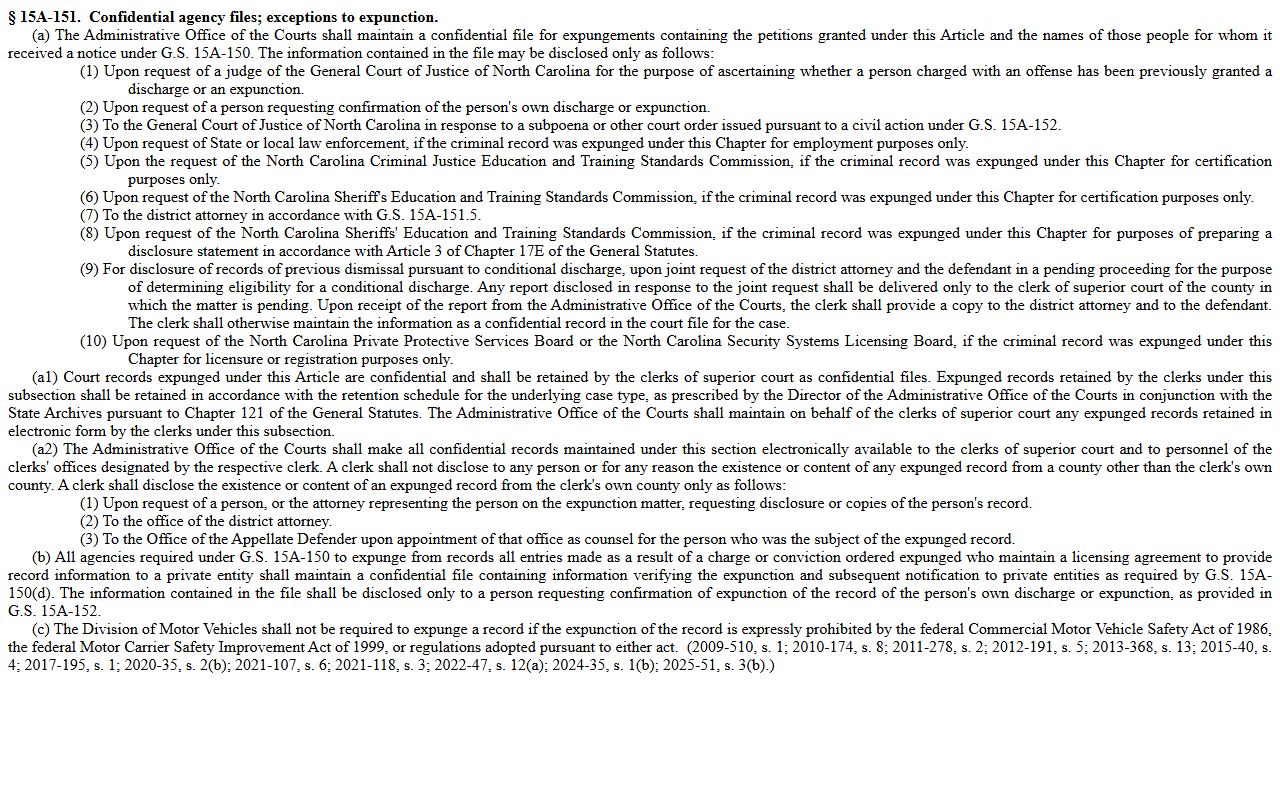
That confidentiality rule protects qualifying expunction materials even when other parts of the court system are open for public inspection.