
Montgomery County Probate Records Office
North Carolina probate in Montgomery County is handled by the Clerk of Superior Court. The North Carolina Judicial Branch estates topic states that the elected Clerk of Superior Court in each county acts as the probate judge. Elected clerks and assistant clerks hold most estate hearings and preside over most estate matters. If the validity of a will is challenged in a caveat proceeding, the dispute is heard by a Superior Court judge.
That structure matters for Montgomery County probate records because the courthouse clerk is both the record keeper and the probate decision-maker for most estate administration. Probate records may involve wills, applications, inventories, accountings, creditor notices, orders appointing personal representatives, year's allowance matters, summary administration, small estate administration, guardianship, and related special proceedings. Some basic case information may appear in Portal, but the clerk's office remains the source for paper files and certified copies.
Clerk of Superior Court Probate Office
108 E Main St
Troy, NC 27371
(910) 571-3700
Monday-Friday, 8:00 AM-5:00 PM
Courthouse Mailing Address
Montgomery County Courthouse
PO Box 527
Troy, NC 27371
(910) 571-3700
Use when directed by clerk instructions.
The Judicial Branch estates help topic is the main state source for wills, estate administration, and the clerk's probate role.
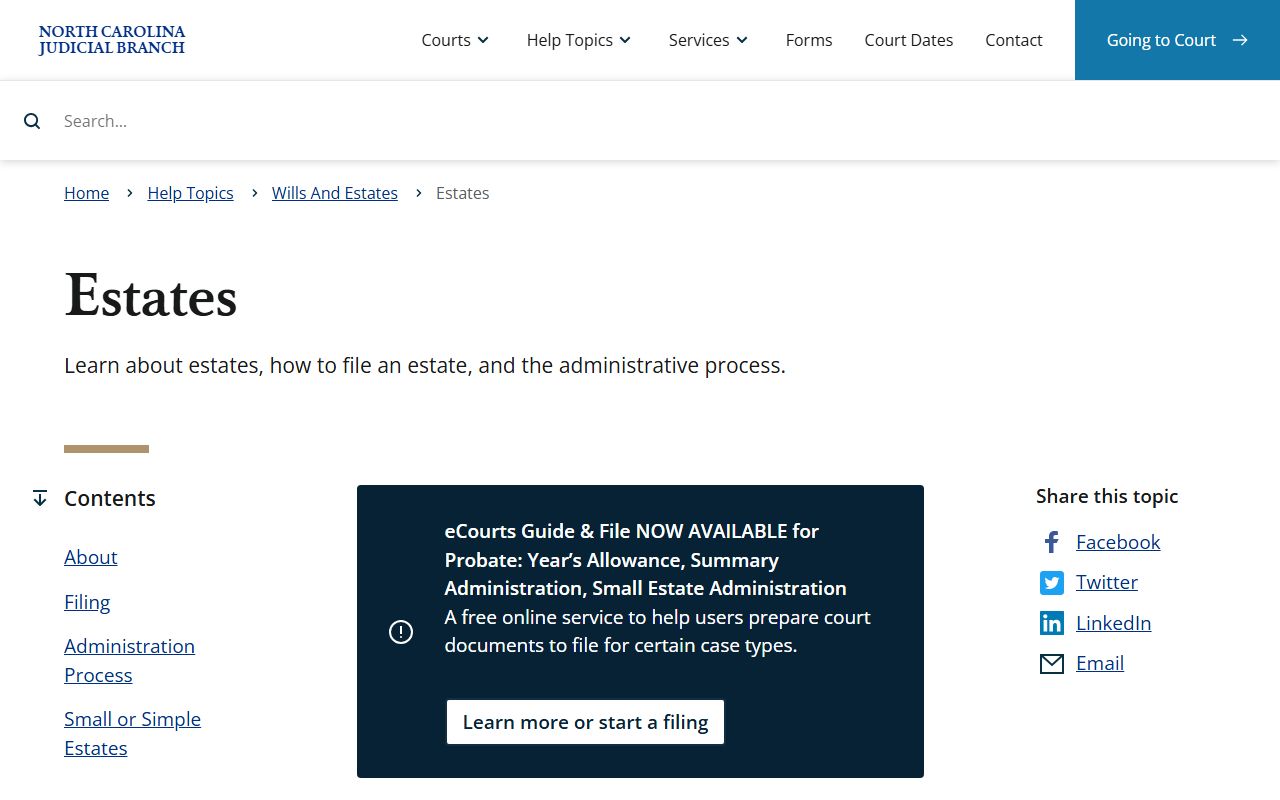
That source explains why Montgomery County probate records are handled by the Clerk of Superior Court acting as probate judge.
Montgomery County Probate Terms
Probate filings use terms that are more specific than ordinary court records. The terms below help distinguish the person who died, the person who handles the estate, and the proceeding type. North Carolina wording may differ from labels used in other states, so the clerk's instructions and Judicial Branch forms should control when a filing is prepared.
- Testator
- A person who made a will before death.
- Executor
- A person named in a will to carry out the will and administer the estate, if appointed by the clerk.
- Intestate
- Dying without a valid will, which means distribution follows state law rather than written will terms.
- Guardianship
- A court-supervised arrangement for a minor or an adult who needs a legally appointed decision-maker.
- Conservatorship
- A term used in some states for financial management of another person's affairs; in North Carolina, confirm the correct guardianship or estate term with the clerk.
Search Montgomery County Probate Records
Montgomery County estate case information may be searched through the North Carolina eCourts Portal by record number or party name, with Montgomery County selected as the location. Probate searches often use a decedent name, personal representative name, estate file number, or filing date range. Portal can help locate case information, but it should not be treated as a complete online document vault for every will, inventory, accounting, or certified probate copy.
For older estates, paper probate files, certified copies, and complete file review, use the Clerk of Superior Court at the courthouse in Troy. The Judicial Branch court-record access guidance says civil, special proceeding, and estate case information can be accessed on public self-service terminals in clerk offices. The file for a court case can be viewed by visiting the clerk's office in the county where the case is located, and staff can provide copies for a fee.
| Field Label | Type | Required | Options / Format Notes |
|---|---|---|---|
| Portal Smart Search record/name field | text | required for online search | Search decedent, personal representative, party, or record number if known. |
| Location | dropdown | optional but useful | Select Montgomery County to narrow the estate search. |
| Case Type | dropdown | optional | Dynamic options may help narrow estates or special proceedings when available. |
| File Date Start / End | date | optional | Useful for newer estate filings. |
| Clerk paper file request | in person / phone | n/a | Provide decedent name, date of death, and estate file number if known. |
- Search Portal with the decedent name, representative name, or estate file number.
- Filter by Montgomery County if the statewide search returns too many matches.
- Check whether the case appears as an estate, special proceeding, guardianship, or related matter.
- Use the courthouse clerk for paper files, certified copies, and older records not clear online.
- Ask the clerk about current copy charges, certification, and whether a record is restricted.
How Montgomery County Probate Works
Estate administration begins when a person's property does not pass entirely outside probate. The Judicial Branch explains that a representative may need to be appointed by the court to collect assets, pay valid debts, and distribute what remains to heirs or beneficiaries. A decedent is the person who died. An estate is the money and property owned at death. A will has no legal effect until probated by a court, usually through the Clerk of Superior Court.
Montgomery County estate administration can be full administration, but smaller estates may qualify for simpler processes. The clerk gives authority to a personal representative, who inventories assets, gives public notice to creditors, pays valid debts, and accounts to the clerk. If a will is contested, a caveat proceeding can move the dispute to a Superior Court judge. That contested-will path is different from routine probate administration before the clerk or assistant clerk.
- Determine whether probate is needed or whether assets pass by beneficiary, survivorship, or other nonprobate path.
- Contact or visit the Clerk of Superior Court at the Montgomery County Courthouse.
- Use Guide & File when the estate fits Year's Allowance, Summary Administration, or Small Estate Administration.
- File the will if one exists and submit the required estate application or forms.
- The clerk or assistant clerk reviews appointment of the personal representative.
- The representative inventories assets, gives notices, pays valid debts, and accounts to the clerk.
- If the will is challenged, the dispute may move before a Superior Court judge in a caveat proceeding.
Montgomery County Guide and File Options
North Carolina eCourts Guide & File is available for some probate filings. The estates research identifies Probate: Year's Allowance, Summary Administration, and Small Estate Administration as Guide & File options. That means a Montgomery County user may be able to prepare certain estate forms through the guided system before filing them with the court process. Guide & File does not decide whether a person is eligible, and it does not replace the clerk's review.
Year's allowance can help a surviving spouse or eligible child claim a limited allowance from an estate. Summary administration and small estate administration are simplified paths for qualifying estates. Full administration is still needed when the estate does not fit a simpler option, when assets or debts require a longer process, or when disputes arise. The safest filing route is to verify the correct estate path with the Clerk of Superior Court before relying on a simplified form.
Note: Guide & File helps prepare forms, but the Montgomery County clerk still controls filing review and probate authority.
Montgomery County Probate Fees
The inspected research sources did not expose a Montgomery-specific estate filing-fee table. Probate charges can depend on the filing type, estate value, copy request, certification, and current statewide court-cost rules. Because the research does not provide exact local dollar amounts for estate filings, the correct content is a fee-routing table rather than invented amounts.
| Probate Item | Amount or Access Rule |
|---|---|
| Estate filing fee | Confirm current filing cost with the Clerk of Superior Court before filing. |
| Year's Allowance, Summary Administration, Small Estate Administration | Use Guide & File if eligible, then confirm filing cost and process with the clerk. |
| Certified probate copies | Confirm current copy and certification charges with the clerk at (910) 571-3700. |
| Paper estate file review | Available through the clerk's office unless the record is restricted or sealed. |
| Federal bankruptcy records | Separate from county probate; use federal bankruptcy court or PACER when the matter is a bankruptcy case. |
Note: The absence of a published Montgomery-specific probate fee table is not a no-fee finding; it means fees must be confirmed with the clerk.
What Montgomery County Probate Records Show
Montgomery County probate records may show the decedent's name, estate file number, filing date, personal representative, heirs or beneficiaries, will filing, inventories, creditor notices, accountings, orders, distributions, and closing activity. Guardianship and special proceeding records can include different parties and orders. Some details may be visible in online case information, while documents and certified copies may require a courthouse visit.
| Record Field | What It May Show |
|---|---|
| Estate file number | The clerk's case identifier for the estate or special proceeding. |
| Decedent | The person whose estate is being administered. |
| Personal representative | The executor, administrator, or other appointed person handling the estate. |
| Will status | Whether a will was offered, probated, challenged, or unavailable. |
| Inventory and accounting | Assets, debts, distributions, and reporting to the clerk when filed and public. |
| Orders | Clerk or judge actions on appointment, allowance, sale, guardianship, or estate closing. |
Restricted Montgomery County Probate Records
Probate files are often public, but that does not make every document or detail open. Guardianship matters can include sensitive personal, medical, financial, or minor-related information. Adoption records, mental-health proceedings, protected identifiers, sealed filings, and restricted juvenile material should not be described as freely searchable. Public copies may be redacted to remove Social Security numbers, account numbers, protected addresses, and other personal identifiers.
Vital records are also governed by a different access rule. North Carolina vital-record statutes control birth, death, marriage, and similar certificates. A death certificate may be relevant to probate, but the certificate access channel is not the same as the estate case file. Marriage and divorce records have their own routing through the Register of Deeds, Clerk of Superior Court, or North Carolina Vital Records.
The North Carolina vital-records statute source explains why certificates connected to estate work are not the same as probate court records.
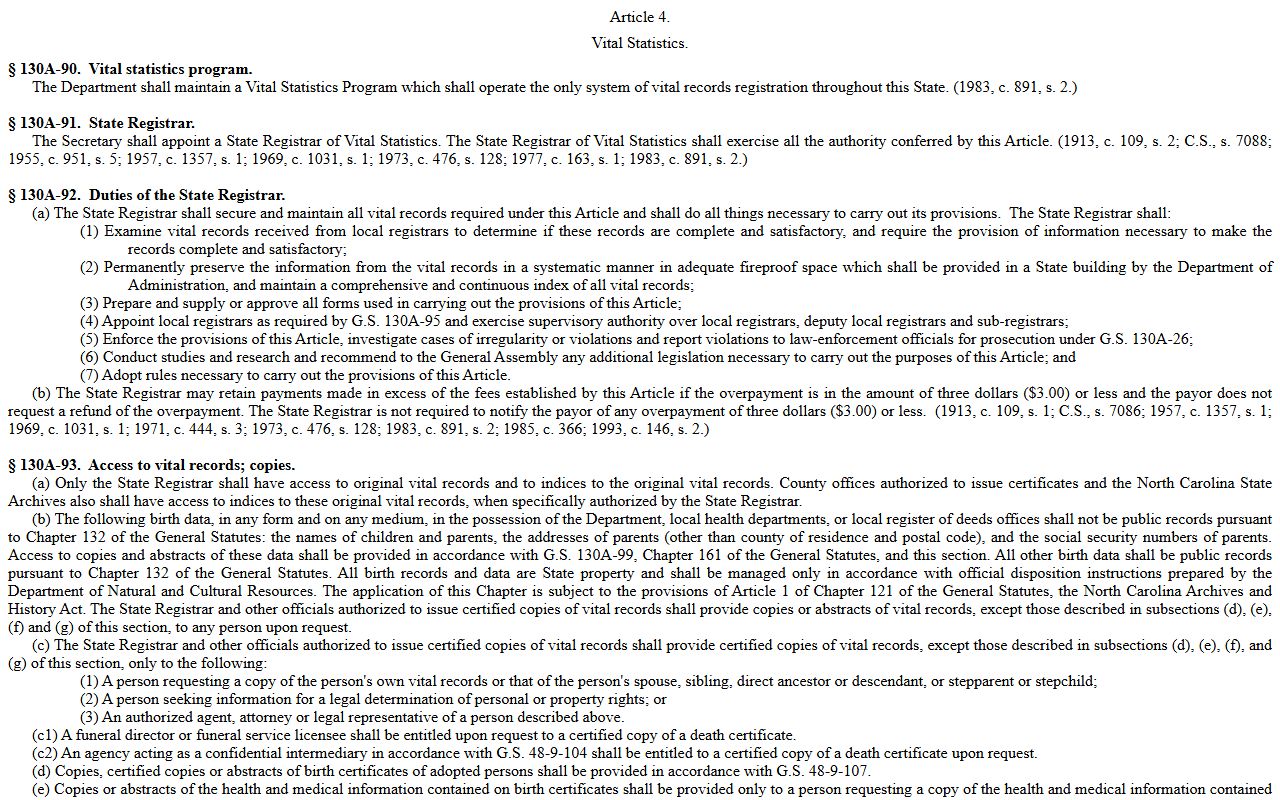
That distinction helps keep estate file requests separate from certificate requests handled under vital-record rules.
Probate Records and Bankruptcy
County probate and federal bankruptcy are different systems. A Montgomery County estate file is handled by the Clerk of Superior Court acting as probate judge. A bankruptcy case is filed in federal bankruptcy court and is searched through the federal court system. The research identifies bankruptcy for Montgomery County as part of the U.S. Bankruptcy Court for the Middle District of North Carolina, with PACER as the federal case-access system.
Bankruptcy may affect an estate when debts, claims, or federal filings overlap with probate issues, but the records are not stored in the same place. Use Montgomery County probate channels for wills, estate administration, clerk orders, and local estate copies. Use federal bankruptcy court or PACER for bankruptcy docket sheets and federal bankruptcy documents.
The PACER lookup for the Middle District of North Carolina Bankruptcy Court is the federal case source, not the county probate file source.
The federal bankruptcy source is included to show the boundary between estate records in Troy and federal bankruptcy records in the Middle District.